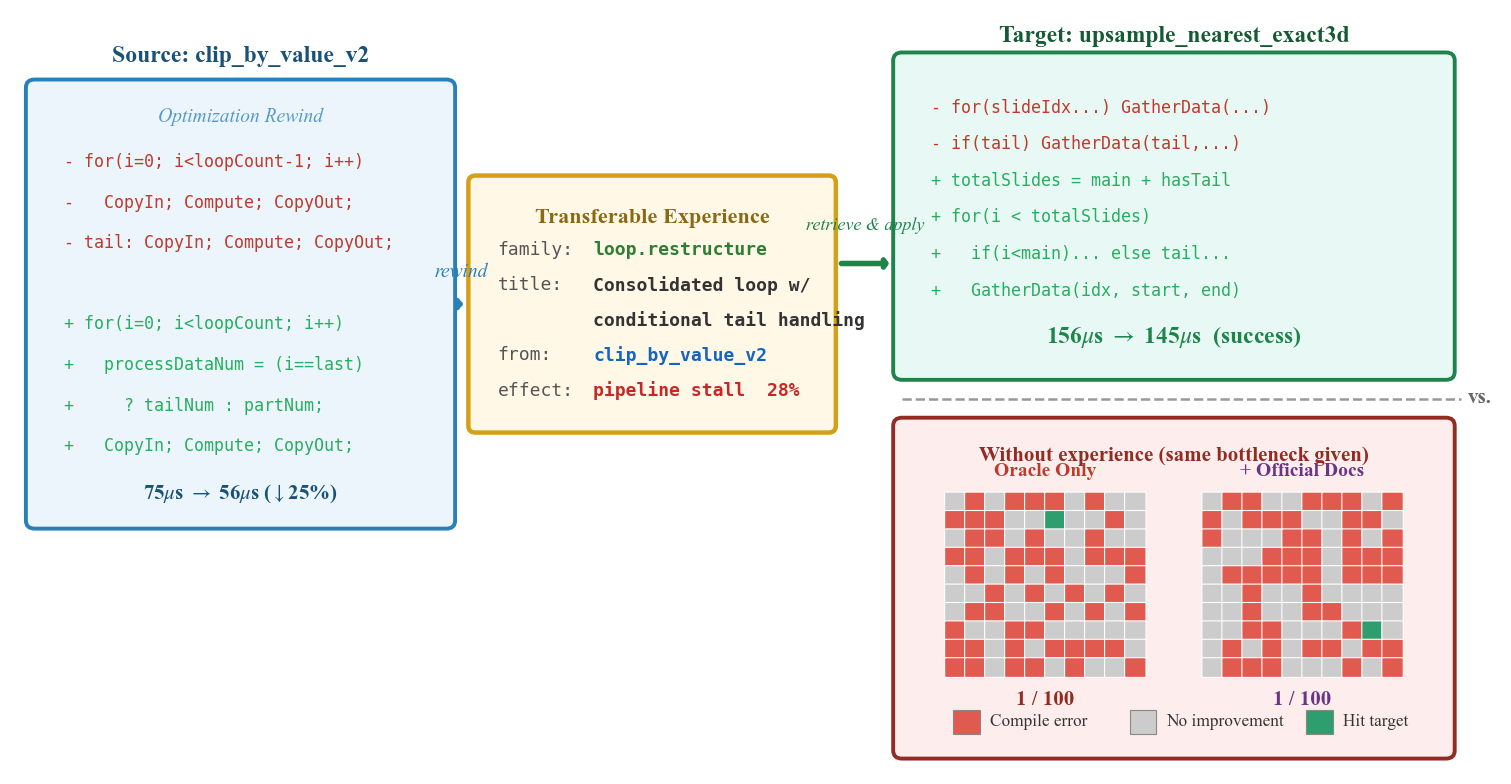
Offline — Build experience
Retain removals that preserve correctness and increase latency beyond profiling noise.
Ascend NPU, training-free optimization
Episodic Agent for Ascend NPU Operator Optimization
Turning strong kernels into reusable experience — and hardware feedback into faster operators.
Method
Starting from correct AscendC implementations, the agent removes optimization motifs, validates slowdowns, and distills inverse edits into reusable experience.
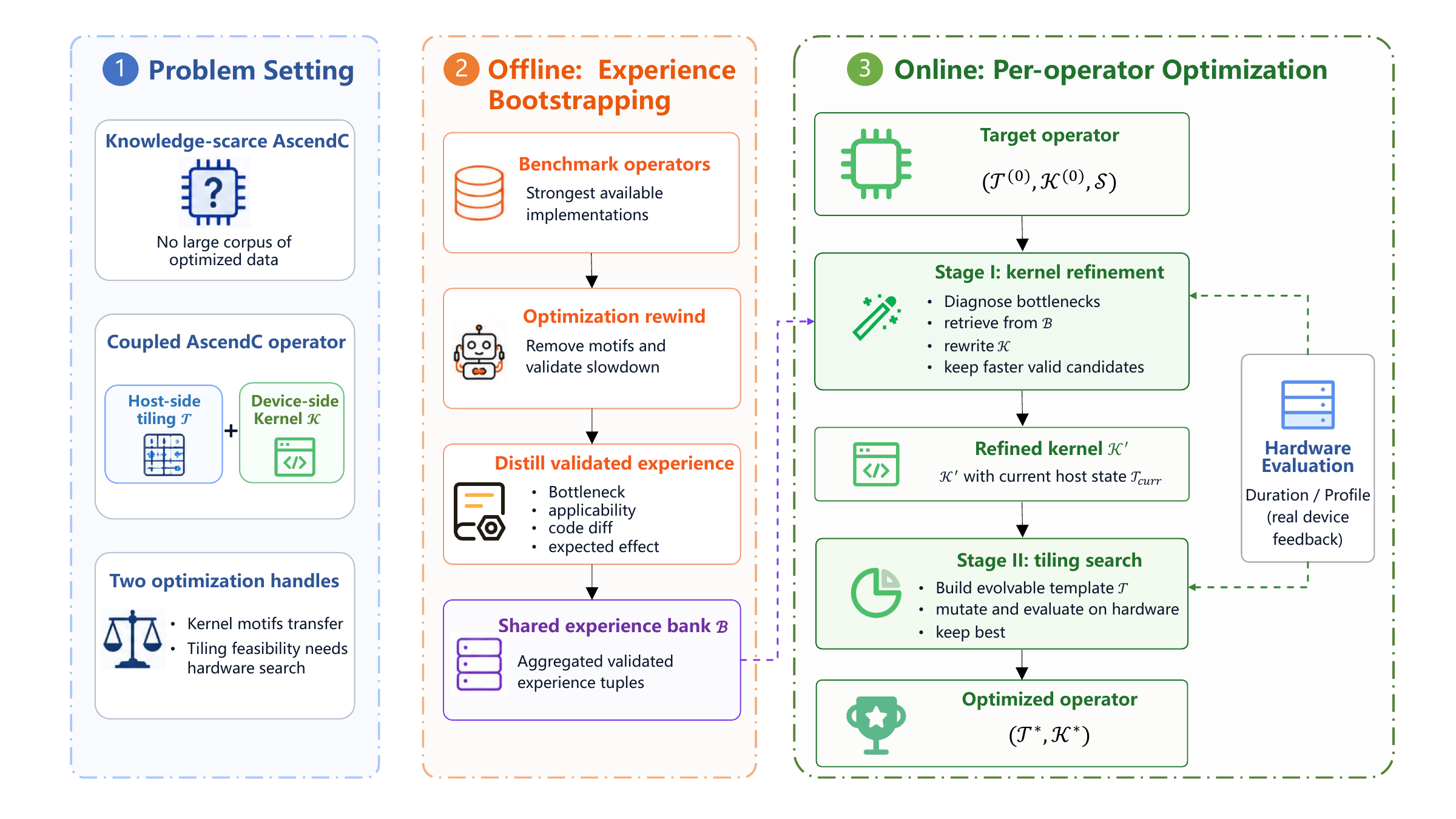
Retain removals that preserve correctness and increase latency beyond profiling noise.
Retrieve from the frozen bank; retain kernel rewrites that pass correctness checks and reduce measured latency.
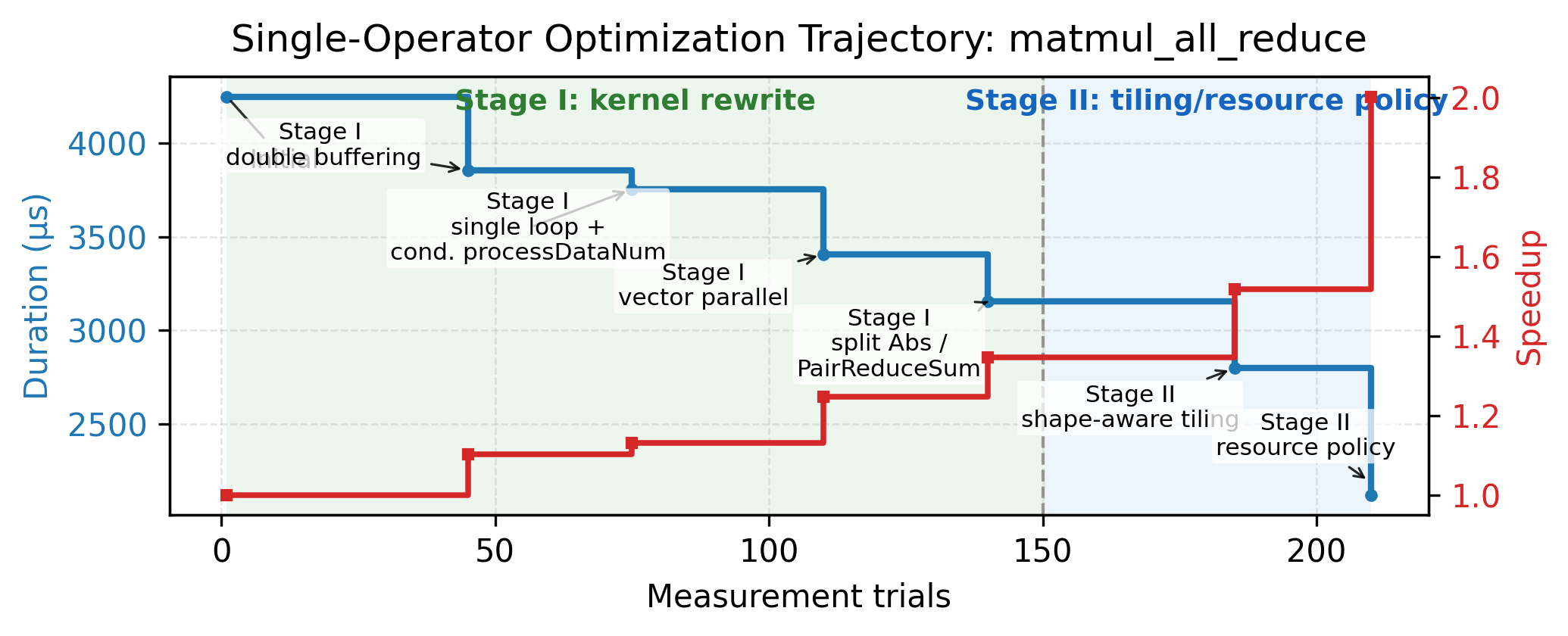
Keep the refined kernel fixed; evolve tile sizes, core counts, and resource policies on hardware.
Results
Ascend 910B2 · CANN 8.3 · DeepSeek-V3.2
Geometric-mean speedup over cann-ops references
Results and figure numbering follow the revised manuscript; they differ in places from arXiv v2.
Same budget. Stronger results. Main-comparison methods receive 230 compile–correctness–profiling attempts per operator, including failures and timeouts. AscendOptimizer uses 20 for Rewind and 210 for online optimization.
Transductive main benchmark. The experience bank is built across the same 101 operators. Held-out transfer is evaluated separately.
Independent runs: tiling only 1.02× GM; kernel refinement without experience 1.09×; kernel refinement with Rewind 1.14×; full system 1.21×. These are not sequential checkpoints (Table 3).
On a matched 25-operator subset, Rewind reaches 1.24× GM versus 1.12× for a documentation-derived bank, with the retriever, prompts, harness, and budget held fixed (Table 4).
On eight held-out loss operators with DeepSeek-V4-Pro and equal budgets, the frozen-bank system reaches 1.06× GM versus 1.02× with Rewind and retrieval disabled. Neither these operators nor their results enter the bank (§4.6).
Evidence in practice
Original paper figures · Click either image for full resolution